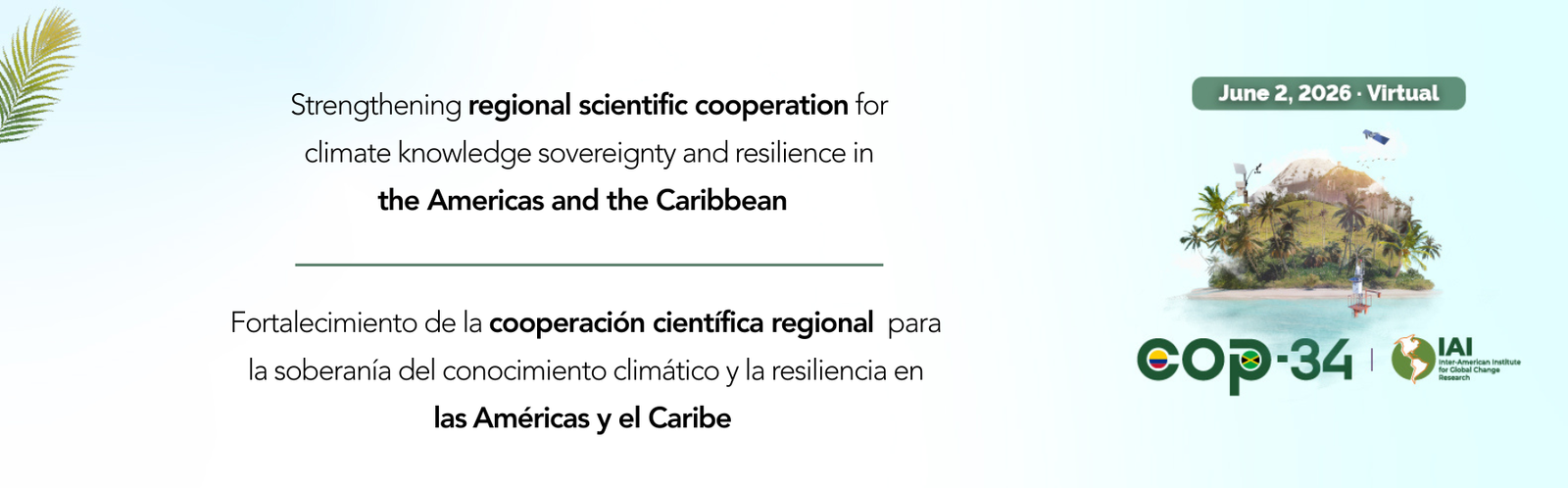
Strengthening Regional Scientific Cooperation for Climate Knowledge Sovereignty and Resilience in the Americas and the Caribbean
Thematic event organized within the sidelines of the official sessions of the 34th Conference of the Parties of the Inter-American Institute for Global Change Research (CoP-34).
Date: 2 June 2026
Time: 9:00–1:00 (UTC-5)
Register here to receive the Zoom link: https://us06web.zoom.us/webinar/register/WN_MbbJ4rCpSKiEo8lOaUeJQw
See the agenda: http://iai.int/wp-content/uploads/2026/05/Agenda-event-en.pdf
This event is jointly hosted by the Government of Colombia and the Government of Jamaica, organized in collaboration with the Institute of Hydrology, Meteorology and Environmental Studies (IDEAM) and the University of the West Indies (UWI), with contributions from the World Meteorological Organization (WMO).
The event will explore opportunities to develop shared tools and collaborative infrastructures, such as regional data platforms, interoperable climate information systems, and digital climate intelligence capacities, to support climate research, risk assessment, and evidence-based decision-making across the region.
It will also examine how enhanced regional cooperation can contribute to strengthening scientific autonomy, promoting sustainable financing for climate research, and reinforcing the long-term resilience of scientific institutions and knowledge networks.
Objective
The objective of this thematic session is to facilitate a dialogue among member countries of the Inter-American Institute for Global Change Research and regional partners on strategic approaches to strengthening scientific cooperation in the Americas and the Caribbean. The session will explore opportunities for developing shared tools and collaborative infrastructures—such as regional data platforms, interoperable climate information systems, and digital climate intelligence capabilities—that can support climate research, risk assessment, and evidence-based decision-making across the region.
The discussion will also consider how enhanced regional cooperation can contribute to greater scientific autonomy, promote sustainable financing for climate research, and strengthen the long-term resilience of scientific institutions and knowledge networks.
Key topics
The session will explore themes that integrate priorities identified by IAI member countries:
- Climate Extremes and Risk Intelligence
Advancing regional capacities to understand and quantify climate hazards, including extreme events, attribution science, and emerging systemic risks. - Digital Climate Intelligence and Data Cooperation
Strengthening regional collaboration in climate data sharing, artificial intelligence applications, high-performance computing, and climate information platforms that support early warning systems and decision-support tools.
Across these discussions, particular emphasis will be placed on strengthening science–policy interfaces and regional governance mechanisms, as well as exploring sustainable financing pathways and enhancing regional research capacity. These cross-cutting dimensions will inform all thematic areas, supporting more integrated, actionable, and regionally coordinated approaches to climate resilience across the Americas and the Caribbean.
Expected Outcomes
The session is expected to:
- Facilitate a strategic dialogue among IAI member countries and regional institutions on priorities for strengthening climate science cooperation.
- Identify opportunities for developing shared regional scientific tools and digital climate information infrastructures.
- Highlight pathways to enhance long-term sustainability and financing of climate research in the region.
- Contribute to strengthening collaborative scientific networks across the Americas and the Caribbean.
Speakers and moderators
Rodney Martínez (World Meteorological Organization), David Smith (The University of the West Indies), Jhordanne Jones (The University of the West Indies), Paola Arias (Universidad de Antioquia, Colombia), Julio León (IDEAM, Colombia), Christopher Record (National AI Task Force, Jamaica), Elizabeth Patiño (IDEAM, Colombia), Toshiyuki Yamasaki (Asia-Pacific Network for Global Change Research – APN), Jorge Concha Carballido (CAF – Development Bank of Latin America and the Caribbean), Julián Prieto (Universidad de Toronto), Miguel Fernández (FONPLATA) and Mirey Atallah (UNEP).
Register here to receive the Zoom link: https://us06web.zoom.us/webinar/register/WN_MbbJ4rCpSKiEo8lOaUeJQw