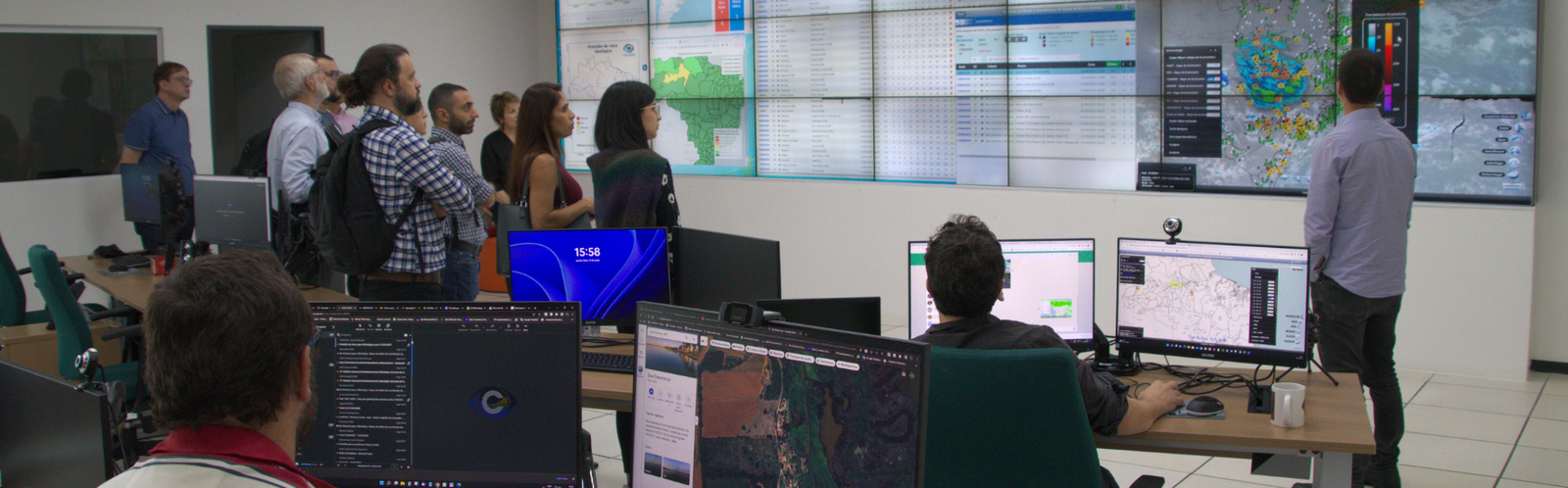
As administrator of SISSA, the IAI contributed to the impact of its information system. The Drought Information System for Southern South America (SISSA) integrates meteorological services, universities, and agencies to move from maps to actions in agriculture, energy, and navigation. In this way, the Southern Cone gains weeks of advance notice to adjust planting and irrigation, schedule national drought plans, and avoid river transport strandings.
- The Drought Information System for Southern South America (SISSA) provided key inputs for these countries to develop their national drought plans.
- SISSA continuously provides tools and information on droughts and their impacts to governments, non-governmental and private institutions, and individuals.
- This information system is a knowledge infrastructure designed to reduce vulnerability and enable anticipatory and precautionary measures to be taken in response to risk.
In 2021, the Paraná River, the backbone of river trade in the Southern Cone, fell to levels rarely seen in decades. In ports along the La Plata basin, barges and tugboats recalculated loads, routes, and costs; thousands of producers feared that the harvest would not be delivered on time. This was not an isolated event: between 2019 and 2022, the basin experienced a severe drought with extreme low water levels in its rivers. For millions of people in Argentina, Bolivia, Brazil, Chile, Paraguay, and Uruguay, this turned the word “drought” into a concrete threat to their jobs and income.
What has changed since then? The region has better organized its science for public decision-making. The Drought Information System for Southern South America (SISSA) coordinates meteorological and hydrological services, universities, agencies, and the private sector to monitor and predict drought, anticipate impacts, and translate them into actions for agriculture, hydroelectricity, and river transport. It is, in essence, a knowledge infrastructure to reduce vulnerability and gain time in the face of risk.
This “time gained” comes from concrete tools. On its website, SISSA integrates maps and visualizations that show the current and historical status of drought, along with operational forecasts. Among the inputs are indices such as SPI (standardized precipitation), percentiles by time scales (3, 6, 12 months), and products based on series such as CHIRPS/GEFS for 15-day horizons, useful for planting, irrigation, or harvesting decisions.
The approach is not only technical: it is sectoral and co-designed. In agriculture, workshops with users showed how to transform data into decisions (e.g., with management calendars, water stress alerts, logistical adjustments). In hydroelectricity and river navigation, the prioritization of variables and “activation thresholds,” i.e., when an indicator triggers a protocol, accelerates coordination between operators, authorities, and ports. SISSA itself documents impacts and mitigation actions for river transport, a sector that is highly sensitive to low water levels.
The practical usefulness can also be seen at the institutional level. Based on this platform, the countries of southern South America have inputs for national drought plans and, in the case of Argentina, a proposed Action Plan for comprehensive risk management. Science is not limited to describing the phenomenon; it helps to standardize procedures, organize responsibilities, and order investments.
However, its value does not depend solely on algorithms or maps. It depends on its sustainability. The National Meteorological and Hydrological Services (NMHSs) in the region are hampered by budget and personnel constraints that threaten the continuity of products once funding projects end. The lesson is clear: without stable budget lines, science becomes intermittent, and intermittency is the enemy of the warning system.
Therefore, if we want science to solve (and not just explain) droughts, there are three unavoidable steps. The first is to provide a home and a budget for the scientific service. A website and good maps are not enough if the team has to be “reinvented” every year. SISSA needs to be anchored in meteorological and hydrological services with stable funding, dedicated professional profiles (hydro-agroclimatology, data science), and clear rules for interoperability between countries. When the back office works, the response in the field no longer depends on voluntarism.
The second step is to convert indicators into decisions. A falling index or an alert forecast is useless if no one knows who does what and when. That is why thresholds and SOPs are important: simple traffic lights and operational agreements that, when a certain level is crossed, trigger specific actions in agriculture, hydroelectricity, or river transport. This is not theory: it is co-designing with users the “if X happens, then we do Y” approach, with defined responsibilities and timelines. The difference between seeing the low water coming and managing it lies in that signed document.
The third step is accountability. Applied science is improved by measuring it: how much useful anticipation did the forecast provide? How accurate was it by horizon and by country? What public or private decisions were based on these products and with what results? Establishing KPIs and post-event evaluations is not bureaucracy; it is institutional learning for the next drought.
If these three pieces—stable funding, activatable protocols, and performance metrics—are consolidated, science ceases to be a post-crisis narrative and becomes a decision-making infrastructure: the difference between suffering from drought and managing its impact.