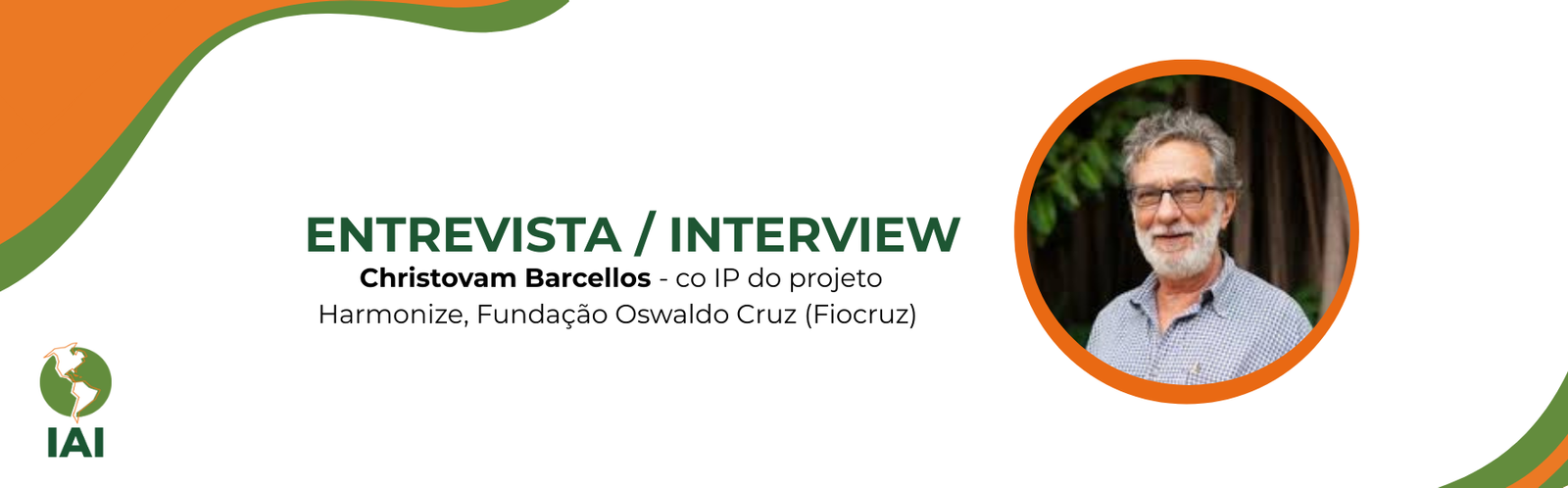
Christovam Barcellos is a researcher at the Oswaldo Cruz Foundation (Fiocruz), an institution that advises the Brazilian Ministry of Health on education, research, and technological development. He coordinates the Climate and Health Observatory, which has been operating for more than 15 years with the mission of monitoring the impacts of climate on health and developing adaptation strategies to address climate change. He is also co-principal investigator of the Harmonize Project, together with co-principal investigators from Cayetano Heredia University (Peru), the University of the Andes (Colombia), and the Dominican Institute of Meteorology (Dominican Republic). The Inter-American Institute for Global Change Research is a partner in this project led by the Barcelona Supercomputing Center and funded by the Wellcome Trust.
In an interview available here, Barcellos shared his experiences with the IAI. “Everything that happens in the climate and the environment is reflected in health,” says Barcellos, “but often indirectly and belatedly, mediated by social and economic factors. That complexity is what makes this work so challenging and so necessary.”
Harmonize: building bridges between climate and health data
The Harmonize project was born from a simple, yet ambitious idea: to create a common language between disciplines that rarely communicate with each other. Health, climate, land use, and economics often operate in isolation, but their interactions determine the lives of millions of people. Harmonize aims to break down these barriers by integrating data and knowledge from these fields, turning fragmented information into useful insights for public health and climate adaptation.
For Fiocruz, Brazil’s leading health research institution, the project opened a new chapter in international collaboration. In collaboration with partners such as the Barcelona Supercomputing Center and the Inter-American Institute for Global Change Research, Fiocruz took on the challenge of developing predictive models and early warning systems that could anticipate risks before they become severe. It is not just about technology, but about creating a framework in which science serves communities in real time.
Regional impact from Brazil to the Andes and the Caribbean
In Brazil, Harmonize focuses on two contrasting landscapes that reveal the country’s ecological and social diversity. The first is the Amazon basin, along the lower Tocantins River, where Chagas disease has become a pressing concern. Surprisingly, its transmission is linked to the cultivation of açaí, a fruit that sustains local economies. The second is the semi-arid northeast, in the state of Paraíba, where prolonged droughts affect water availability and amplify the spread of vector-borne diseases. These regions are not far apart geographically, but they represent radically different realities—an Amazon rainforest and a dry interior—underscoring the need for integrated approaches such as One Health, which views human, animal, and environmental health as interconnected.
Beyond Brazil, Harmonize has fostered exchanges with Colombia, Peru, and the Dominican Republic. These collaborations reveal common challenges, such as limited access to health data, and shared opportunities, such as the availability of environmental information. They also highlight the diversity of Latin America—from the Andes to the Caribbean and the Amazon—and the need for solutions that respect local realities and leverage regional solidarity. For Barcellos, this is one of the project’s greatest achievements: creating a platform where countries learn from each other and build their resilience together.
Local participation and the way forward
One of the guiding principles of the project is local participation. Barcellos insists that sustainability depends on listening to communities and involving them in decision-making. “We often arrive with preconceived ideas,” he admits, “but the people on the ground have different priorities.” In the Amazon, for example, residents alerted researchers to the growing importance of Chagas disease and its link to açaí production. The challenge is delicate: protecting workers and consumers without undermining an economic activity that is vital to the region. This dialogue between science and society is the true “co-production” for Barcellos, a process in which solutions are built collaboratively rather than imposed from outside.
The full interview (in Portuguese) is available here.