
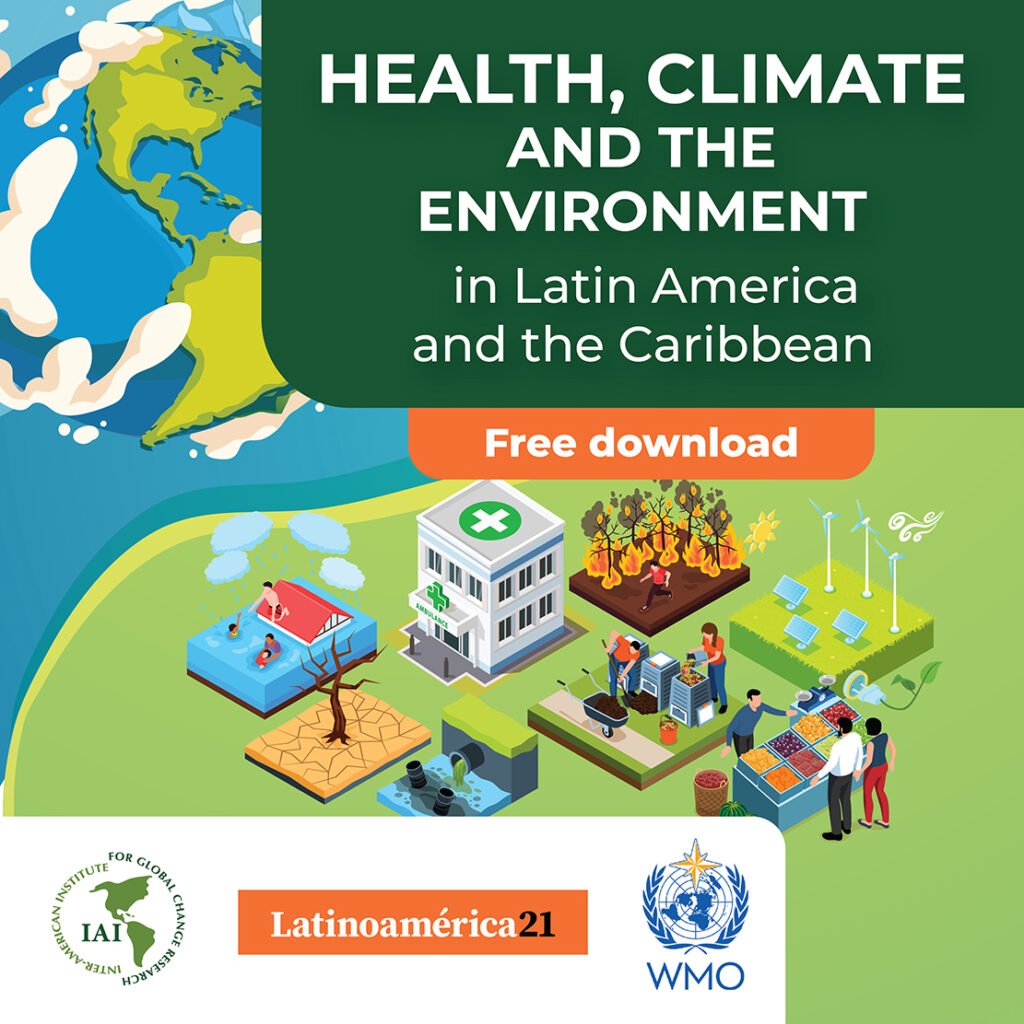
The Inter-American Institute for Global Change Research (IAI) presents its new compendium of commentaries entitled “Health, Climate, and Environment in Latin America and the Caribbean,” which explores the complexities of climate and environmental crises in the region. This book, published in partnership with Latinoamérica 21 and supported by the World Meteorological Organization, addresses the challenges and risks facing the region amid climate and environmental crises, with contributions from leading experts and academics.
From the preface written by Irene Torres to the afterword by María Villarreal, each chapter offers an informed and insightful perspective on crucial issues. Soledad Niño Celio examines the risks and inequalities inherent in these crises, while Victoria Mendizábal questions the possibility of implementing health prevention on a global scale.
Authors Luz Cumba and María Inés Carabajal propose an innovative approach, “One Health,” and advocate for scientific diplomacy to address the consequences of climate change. Carolina Cerrudo highlights the importance of early warning systems as lifelines for global health, backing up her point with Bárbara Tapia Cortés’ contribution on reducing damage from natural disasters by 30%.
Whether exploring the connection between “heat islands” and public health, addressed by Gabriel Sánchez Rivera and Leticia Gómez Mendoza, or the need for green areas to mitigate heat waves, according to Enrique Muñoz and Adán Castro Añorve, the authors explore crucial interconnections between health and the environment.
Patricia Iribarne delves into how our waste affects climate change, while Sonia Alejandra Pou and Camila Niclis propose dual actions to mitigate climate change and prevent obesity. Iohanna Filippi highlights the harmful connection between pesticides, climate change, and obesity.
Irene Torres and Daniel Romero-Álvarez reveal the silent advance of emerging fevers in Latin America, while Hilario Espinosa addresses the inseparable link between climate change and migration, with terrible consequences for the environment. Nicole Arbour closes the collection by reminding us that all elements are interconnected.